Export Packaging Design Standards For WPC Louvers
As a raw material quality control engineer in a professional outdoor WPC factory in Guangdong, China, I inspect every production stage before wpc louvers are prepared for international shipment. Export packaging is not only an outer protection layer. It is part of product quality management because long-distance sea transportation exposes WPC profiles to humidity, temperature changes, vibration, stacking pressure, and handling risks. A reliable packaging design must protect surface appearance, dimensional accuracy, and mechanical performance until installation at the final project site.
Our factory evaluates packaging requirements according to destination climate, container loading method, and customer application. WPC louvers are usually packed with moisture-resistant wrapping films, reinforced corner protection, strong pallets, and customised cartons or wooden frames when required. The packaging structure must prevent scratches, bending, and impact damage while allowing safe forklift movement. Before shipment approval, quality inspectors check package weight, sealing condition, label accuracy, and loading stability.
Raw Material Control Behind Outdoor WPC Performance
The durability of outdoor WPC products starts with accurate control of wood powder, HDPE or PVC polymers, additives, pigments, and modifiers. Wood powder provides natural texture and stiffness, but its moisture content and particle size must be carefully controlled. Excessive moisture can create internal defects during extrusion, while inconsistent particle distribution may affect surface quality and strength. Our incoming material inspection includes moisture testing, particle analysis, and supplier batch verification.
HDPE and PVC polymers determine the bonding strength, flexibility, and resistance of WPC profiles. We test polymer grades, melt flow properties, and material consistency before formula production. A balanced polymer ratio helps wpc louvers maintain shape stability during outdoor exposure. Additives such as UV stabilisers, antioxidants, and processing agents improve resistance against sunlight, oxidation, and thermal ageing. Pigments are selected for colour stability, and modifiers are used to improve impact resistance and reduce brittleness in changing weather conditions.
Factory Inspection Methods For Weather Resistant WPC Products
Quality inspection in our Guangdong factory follows controlled procedures from raw materials to finished profiles. During extrusion, engineers monitor temperature settings, pressure levels, cooling conditions, and production speed because these factors influence internal structure. Finished WPC louvers undergo dimensional inspection to confirm width, thickness, length, and profile tolerance. Surface checks identify colour variation, cracks, bubbles, and extrusion marks that could affect customer acceptance.
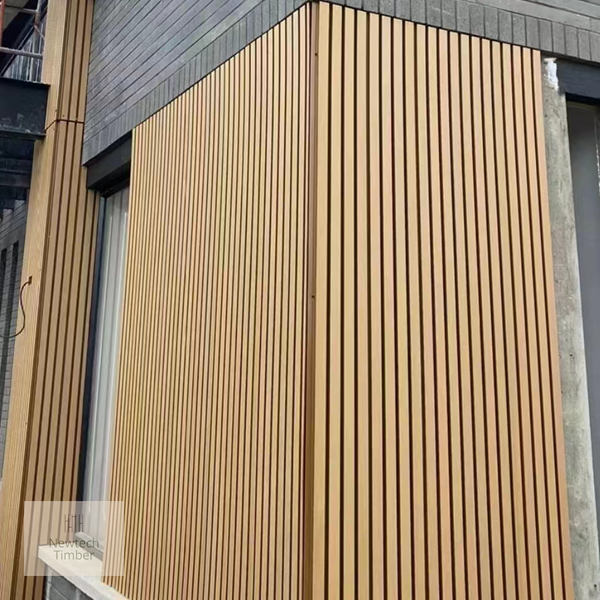
Laboratory testing provides further evidence of product performance. We conduct water absorption tests, density checks, impact tests, and accelerated weathering evaluations. UV ageing tests simulate long-term sunlight exposure to examine colour retention and surface durability. Mechanical testing confirms whether the profile can withstand installation stress and outdoor service conditions. These inspection methods help maintain consistent quality for projects in regions with strong sunlight, heavy rain, coastal humidity, or seasonal temperature changes.
Packaging Protection During International Transportation
International logistics creates different challenges from factory storage. A container shipment may experience weeks of humidity, vibration, and repeated loading operations. For this reason, our export packaging design considers both material protection and transport efficiency. WPC louvers are arranged with separators between profiles to prevent friction damage, and protective layers are added around finished surfaces. Strong pallets distribute pressure evenly and reduce deformation risks during stacking.
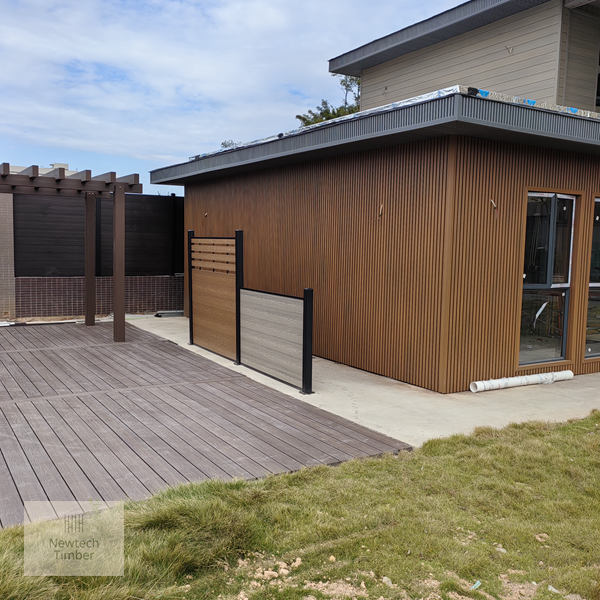
Packaging engineers also check ventilation and moisture control measures. Desiccant materials, waterproof wrapping, and sealed protective covers are commonly used for overseas orders. Before container loading, the quality team verifies product quantity, packaging integrity, and loading sequence. Photographic records and inspection reports are prepared to support traceability and provide clear information for international customers, sales teams, and after-sales service engineers.
Material Selection And Quality Consistency For Global Markets
Outdoor WPC product performance depends on cooperation between formula development engineers, extrusion specialists, quality supervisors, and packaging teams. A small variation in raw material composition can influence colour, strength, and long-term weather resistance. Our factory maintains strict supplier management and production records to ensure every batch meets customer specifications.
For architects, landscape consultants, and international buyers, reliable wpc louvers require more than attractive appearance. They need stable materials, controlled manufacturing processes, and professional export preparation. By combining accurate raw material inspection with suitable packaging designs, WPC factories can deliver products that maintain their quality from Guangdong production lines to outdoor applications around the world.

